The Spend-Where-You-Touch Rule: Allocating a Kitchen Budget in 2026

Photo: Tony Atkin, CC BY-SA 2.0, via Wikimedia Commons
Most kitchen budgets don't collapse in a single dramatic moment. They leak. A little extra on a statement splashback, a spur-of-the-moment upgrade on a tap you liked in a showroom, a cheaper hinge pack because nobody sees hinges. Then the drawers start to grumble, the extraction struggles through a Sunday roast, and the money has already gone somewhere less useful.
The high-low approach isn't about buying cheap where you can and expensive where you can't. It's about spending deliberately. In 2026, with appliance lead times still needing a diary and plenty of homeowners balancing a once-in-twenty-years project against ordinary life, the useful question isn't 'What is the best kitchen?' It's 'Which parts of this kitchen will I touch, use and notice every single day?'
Start with the things your hands remember
A kitchen is a physical relationship. You open drawers, turn taps, pull doors, wipe worktops, reach for switches. Those repeated contacts are where money tends to earn its keep.
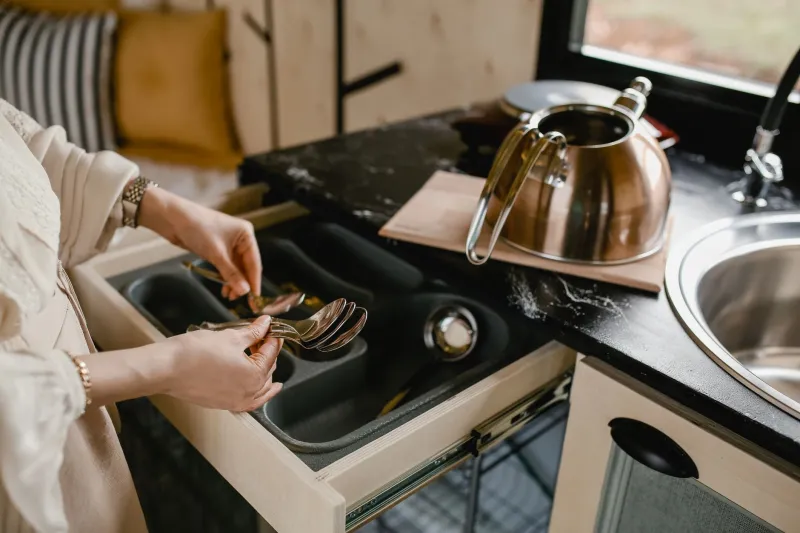
Drawer boxes and runners are a good example. A well-built drawer that glides smoothly when it's full of tins and settles softly when you close it with your hip is a daily pleasure. A cheap runner that sticks, sags or needs a firm shove is a daily irritation. The same goes for hinges. Nobody admires a hinge, but a soft-close door that has stayed aligned after three years of family use is a quiet kind of luxury. Cheap hinges are one of the clearest false economies in a kitchen: they are fiddly to replace, they affect every cabinet door, and they make a good carcass feel worse than it is.
Taps belong in this group too. You use them constantly, often with wet or floury hands. A well-chosen tap with a reliable cartridge and a spout that reaches where it should is worth stretching for. It doesn't need to be the most theatrical design in the showroom. It needs to work properly, day after day.
Worktops: spend for the way you actually cook
Worktops are where budget decisions get emotional. They are the largest visible surface, they carry a lot of design weight, and it is easy to let one slab eat the whole allowance. But the right question is not 'Which worktop looks most expensive?' It's 'What does this surface have to survive?'
If you bake bread, chop vegetables, rest hot pans and occasionally forget a red wine glass, a worktop that can take those knocks without anxiety is money well spent. If your kitchen is mostly a coffee-and-toast operation, a mid-range surface with a sensible edge detail may be perfectly capable. The false economy is not choosing a modest material; it's choosing a delicate material and then living carefully around it. A worktop that makes you nervous every time you put down a pan is not a bargain, whatever it cost.
Light the work, not just the room
Task lighting is one of the most under-budgeted parts of a kitchen. A beautiful pendant over an island is lovely, but it rarely helps you see the onion you are chopping at 6pm in November. Under-cabinet lighting, good socket placement and a considered layer of light around the worktop make the room feel calmer and more capable. This is a place to spend a little more thought, and often a little more money, than the initial plan allows.
Where can you save? Decorative lighting can be simpler. You don't need every layer to be a feature. Let the practical light do the quiet work and let one pendant or wall light carry the visual moment.
Extraction and the invisible false economy
Extraction is the kitchen equivalent of insurance: dull to discuss, expensive to get wrong. An under-specified hood or a weak ducting route can leave steam, smells and grease exactly where you don't want them. In an open-plan room, that affects the whole house. This is not the place to shave the budget without understanding what you are giving up.
Spend on the motor and the route, not necessarily on the most sculptural hood. A capable, well-ductured extractor that suits the layout will do more for daily life than a designer statement that recirculates lukewarm air. If the ducting run is awkward, address it early. Moving extraction later is rarely cheap.
Where standard is genuinely fine
There are plenty of places where mid-range or standard choices will barely register in daily use. Cabinet carcasses from a reputable supplier, internal shelf boards, handle styles, wall paint, decorative end panels and open shelving can all be sensible places to save. None of them are false economies if they are specified properly and fitted well.
Appliance brands are a more nuanced area. A mid-range oven from a trusted manufacturer may cook beautifully; a premium badge does not automatically make better roast potatoes. Spend where the appliance solves a real problem for you, whether that is a larger hob, a quieter dishwasher or a fridge with sensible storage. Save on the second oven you will use twice a year if the budget is tight.
A simple framework for 2026
Think in three pots rather than one long list. First, the daily-touch pot: drawers, hinges, taps, worktop, task lighting and extraction. Second, the fabric pot: carcasses, doors, flooring and decoration. Third, the look-at-it pot: statement surfaces, feature lighting, splashbacks and decorative details.
Most budgets feel better when the first pot is protected and the third pot is allowed to flex. That doesn't mean the look-at-it pot is unimportant. It means the kitchen should work before it performs. If you have to choose, choose the drawer that closes properly over the splashback that photographs beautifully.
A kitchen is not a showroom. It is a room you will use on ordinary Tuesdays, at Christmas, during homework and after long days. Spend where your hands and eyes will thank you. Save where standard is genuinely good enough. That is not a compromise budget; it is a deliberate one.