Plug In, Tuck Away: Giving Countertop Appliances a Proper Home
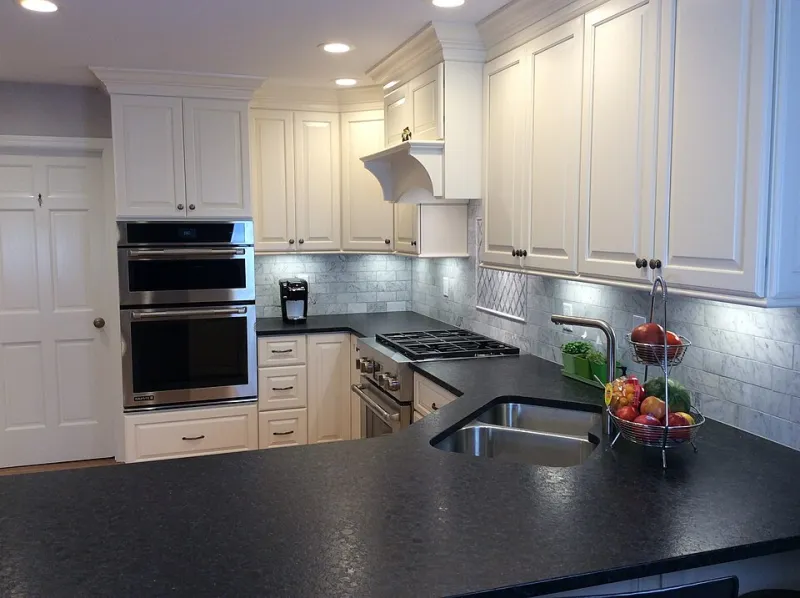
Photo: XanderL, CC BY-SA 4.0, via Wikimedia Commons
Every kitchen has a countertop creep. It starts with one air fryer. Then a coffee machine arrives, then a blender, then a stand mixer, and before long the worktop is a power-strip graveyard with a toaster wedged in the middle. The answer is not to ban the appliances. It is to give them a proper home — one that is designed around how you actually cook, not how you wish you cooked.
The appliance station, not the appliance graveyard
A dedicated appliance station is usually 600–900mm wide, 400–600mm deep, with worktop at the standard 900mm height. It should sit near the main prep area but out of the primary triangle between sink, hob and fridge. The idea is simple: everything you use regularly has a parking space, a plug and enough breathing room. Everything else lives elsewhere.
For an air fryer, allow at least 10–15cm of clearance at the back and sides, and never run it inside a closed cupboard. Coffee machines need access to water and enough height above for beans and cups. Blenders need headroom — often 450mm or more — so measure the machine with the lid on. A station that fits the appliance with 5mm to spare is not a station; it is a trap.
Power and heat: the unglamorous details
In a UK kitchen, plan double sockets at 100–150mm above the worktop, or inside an appliance garage with cable grommets. Air fryers typically draw 1,500–2,000W, kettles up to 3kW, and coffee machines around 1,400W. Do not daisy-chain them through a cheap extension lead. If you are having a new circuit fitted, tell your electrician what you plan to run.
If you want an appliance garage, ventilate it properly. Fit grilles top and bottom, use a heat-resistant shelf, and leave the door open during use. A pull-out shelf with a heatproof mat is often better than a sealed cupboard because it lets steam escape. Do not put a hot air fryer next to a toaster and then close the door on both. That is how you turn a design feature into a fire risk.
Pull-out shelves and the weight question
A pull-out shelf is brilliant for a heavy stand mixer or a large air fryer, but only if the runners are rated for it. Look for full-extension runners rated to 25–30kg, with a stop so the shelf does not slide out when you lean on it. Avoid pull-outs for appliances that produce a lot of steam — rice cookers and slow cookers — unless the cabinet is ventilated and you can leave the door open.
For coffee machines, a pull-out drip tray is a nice touch, but a fixed shelf at counter height is simpler and more robust. If you are planning a plumbed-in coffee machine, sort the water supply and waste before the cabinets go in. Retrofitting is expensive and messy.
What stays out, what goes away
Be honest about frequency. If you use it most days, keep it on the worktop but corral it on a tray so it does not spread. If you use it two or three times a week, give it a home in the appliance station with easy access. If it is a monthly thing, put it in a larder or a tall cupboard. If you used it twice in a year, it can live in the loft. The 80/20 rule applies: 80% of the clutter comes from 20% of the appliances.
A soup maker you have used twice is not a reason to sacrifice a whole run of worktop. A coffee machine you use every morning is. Design for the second one.
The storage trade-off that keeps the room calm
You will lose base cabinet space. That is the deal. But you gain worktop, and worktop is the most valuable surface in a small UK kitchen. A 600mm appliance station with a lift-up door can replace a cluttered 1.2m run and make the room feel twice as calm. Use the space above the station for shallow shelves, and the space below for pull-out bins or a slim larder.
Do not put the air fryer next to the toaster if both are used at breakfast. You will create a queue. Do not put the coffee machine in the darkest corner just because it fits. And do not buy an appliance garage before you have measured the appliances — including the handle, the plug and the space needed to open the door.
Ventilation and smells
Air fryers produce steam and smell. Position the station under an extractor if you can, or near a window. A recirculating hood is better than nothing, but it will not work miracles. Keep coffee machines away from kettle steam, and put a rubber mat under the blender to cut noise and vibration. Small details, but they are the difference between a station you use and a station you resent.
A calm kitchen is not one with no appliances. It is one where every appliance has a place. Measure them, check the doors open, plan the power, and then build the cabinet around that reality. Your worktop will thank you.