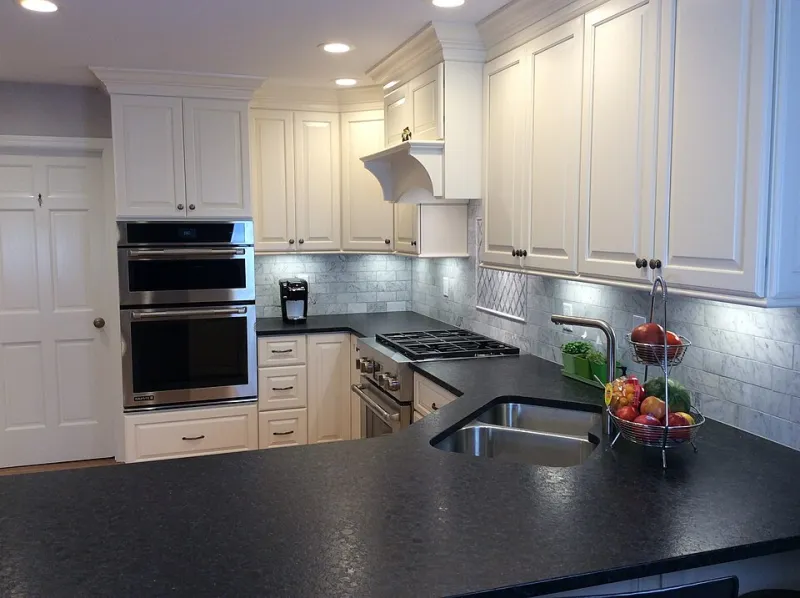
Before You Cut the Worktop: The Real Case for an Instant Boiling-Water Tap
Photo: Sandy Gerrard , CC BY-SA 2.0, via Wikimedia Commons
The showroom demonstration is almost too good. A tap is touched, steam curls up, and a cup of tea appears without the rumble of a kettle. It looks like the future. And sometimes it genuinely is. But an instant boiling-water tap is not just a shinier kettle. It is a small appliance system with plumbing, filtration, electrical demand and a filter cartridge that needs changing. The decision is less about whether the demo impresses you and more about whether the convenience earns its keep in your actual kitchen.
What the demonstration tends to skip
The first thing to ask is what comes out of the tap besides hot water. In much of the UK — especially London, the South East and other hard-water areas — limescale is the quiet enemy of any appliance that heats water. Boiling taps generally rely on filtration or scale-control cartridges to keep scale down and taste clean. That cartridge is not a one-off. It is a recurring cost and a recurring job, usually every six to twelve months depending on water hardness and how much you use the tap.
If you live in a very hard-water area and already battle kettle fur, be realistic. A boiling tap can still work well, but only if the filtration is properly specified and maintained. Skipping cartridge changes is a false economy; you are simply paying later for a scaled-up boiler or a tap that dribbles instead of delivers.
The cupboard and the cable
Under the sink, a boiling-water tap usually needs a boiler unit. Some are compact, some are not, and all of them want space. That is space you may currently use for cleaning products, the recycling caddy, a pull-out bin or the endless plastic bags that every British kitchen accumulates. Before you fall for the tap, open the cupboard and measure honestly. Then measure again with the filter housing and stop valve in place.
The unit also needs power. Often that means a socket or fused connection inside the cupboard, installed by a qualified electrician and planned at first fix. Retrofitting is possible, but it is much easier before the cabinets, worktop and splashback go in. Ventilation matters too; read the manufacturer’s requirements rather than assuming a cupboard is fine because it feels roomy.
Safety is not a footnote
A boiling-water tap dispenses water at around 100°C. That is the point, but it deserves respect. Good models have child locks, spring-loaded levers and often a two-stage operation. Some have insulated spouts. None of that replaces sensible siting. Put the tap where it cannot be knocked by someone reaching across the sink, and think about children, guests and older visitors who may not expect boiling water from a normal-looking mixer.
It is also worth thinking about the everyday choreography. If the tap sits in the middle of your main prep zone, you may find yourself working around a plume of steam. If it is tucked at the edge of a run, it can be awkward to fill a pan. Position is a design decision, not an afterthought.
The running-cost conversation
Sales patter often compares a boiling tap to a kettle and concludes that the tap is cheaper. The truth is more nuanced. A kettle heats only the water you put in it, but it usually heats more than one cup and then you may reboil later. A boiling tap keeps a small tank hot, ready to dispense, and uses electricity to maintain that temperature. It also has filter costs. If you make two cups a day, a decent kettle and a filtered mixer tap will almost certainly cost less to run. If your kitchen is a busy hub with home working, children, frequent tea rounds and a lot of cooking, the tap can make more sense — not necessarily because the electricity is cheaper, but because the convenience is used often enough to justify it.
Use your own habits as the test. Count the kettle boils in a normal week. Then add the filter cartridge cost and the likely standby running cost of the unit you are considering. A good retailer should be able to give you realistic figures rather than a best-case showroom number.
When it genuinely earns its place
Instant boiling water is most convincing in households that boil the kettle constantly, fill pans for pasta and vegetables, sterilise bottles or make up hot drinks throughout the day. It is also handy in a home office kitchen where people drift in and out and do not want to wait for a kettle to come back to life. In those homes, the tap becomes part of the rhythm of the room rather than a gadget.
It also suits kitchens where worktop clutter is a real concern. Losing the kettle frees up a surprising amount of visual space, especially in a compact layout.
When a kettle and a filtered mixer make more sense
Be honest if any of these sound familiar: you rarely boil more than two cups at a time, your under-sink cupboard is already tight, you are in a very hard-water area and do not want another maintenance task, or you are working to a tight budget. A good kettle and a well-chosen filtered mixer tap are not a compromise. They are a sensible, low-maintenance answer for plenty of British kitchens.
If you mainly want better-tasting water, a filtered mixer may give you most of the daily benefit for a fraction of the installation fuss. If you mainly want speed, ask yourself how often you are actually waiting for a kettle. Sometimes the answer is “not much”.
Plan it before the worktop is cut
If you decide to go ahead, choose the model before the first fix. The tap, boiler, filter and power supply all need to be coordinated. Check the worktop hole diameter, the tap’s clearance, the boiler dimensions, the filter access and the electrical requirements. Make sure your installer knows where the isolation valve will sit and how the cartridge will be changed without dismantling the cupboard.
This is the point where a little patience saves a lot of swearing. Do not let anyone cut the worktop until the appliance is chosen and the plumbing and power routes are agreed. An instant boiling-water tap can be a genuinely useful addition to a busy kitchen in 2026 — but only when it is planned as part of the room, not bolted on after the worktop has already been drilled.